

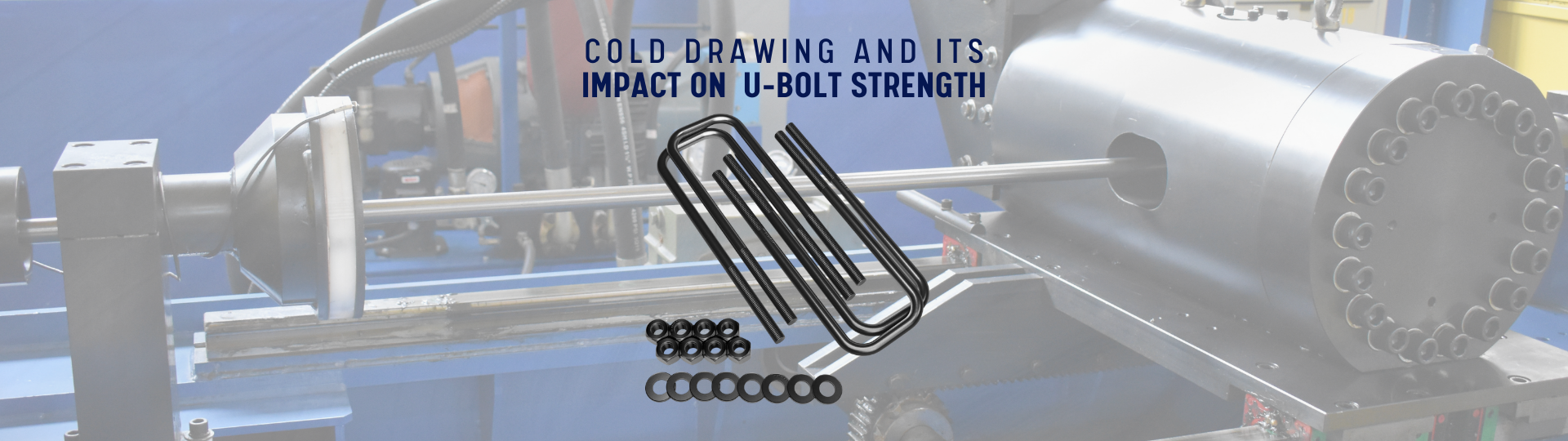
Cold Drawing and Its Impact on U-Bolt Strength in Light and Heavy Truck Suspensions
Introduction
U-Bolts are critical structural components in suspension systems, responsible for securing the axle to the leaf spring assembly. Their performance directly affects vehicle stability, safety, and load distribution. While bending and threading are visible manufacturing steps, the true strength of a U-Bolt begins much earlier — during cold drawing.
Cold drawing fundamentally transforms the mechanical properties of steel, creating the foundation for high-strength suspension fastening solutions.
What Is Cold Drawing?
Cold drawing is a metal forming process in which steel wire rod is pulled through a hardened die at room temperature. This process reduces the diameter while simultaneously increasing material strength through strain hardening.
Unlike hot rolling, cold drawing improves:
-
Dimensional precision
-
Surface quality
-
Grain structure refinement
-
Mechanical strength
It is a controlled deformation process that enhances the internal microstructure of steel.
Metallurgical Impact on U-Bolt Strength
1. Increased Tensile Strength
During cold drawing, plastic deformation aligns and refines the grain structure of steel. This increases dislocation density, resulting in:
-
Higher ultimate tensile strength
-
Improved yield strength
-
Greater resistance to permanent deformation
For U-Bolts exposed to heavy axle loads, this is essential.
2. Enhanced Fatigue Resistance
Suspension components operate under cyclic loading conditions. Repeated stress can cause microcracks and eventual failure.
Cold drawing improves fatigue performance by:
-
Reducing internal structural inconsistencies
-
Creating a more uniform grain flow
-
Enhancing resistance to crack initiation
This significantly extends service life in demanding applications.
3. Improved Dimensional Accuracy
Cold drawing ensures:
-
Tight diameter tolerances
-
Uniform roundness
-
Better fit during bending and threading
This directly affects clamping consistency and torque performance in U-Bolt installation.
4. Better Surface Integrity
A smoother surface finish reduces stress concentration points, which are common origins of fatigue failure.
Improved surface quality also enhances coating adhesion for corrosion protection.
Why It Matters in Light and Heavy Truck Suspensions
Suspension U-Bolts must withstand:
-
High static loads
-
Dynamic impact forces
-
Road-induced vibration
-
Temperature variations
-
Long operational cycles
Any reduction in material quality can compromise vehicle safety.
Cold drawing ensures that the steel used in U-Bolt manufacturing has the structural capacity to endure these conditions reliably.
Integration with Heat Treatment and Thread Rolling
Cold drawing alone enhances strength, but when integrated with:
-
Controlled heat treatment
-
Precision bending
-
Thread rolling (instead of cutting)
-
Quality inspection procedures
The result is a high-performance fastening component suitable for OEM-level applications.
Tekay Automotive Approach
At Tekay Automotive, cold drawing is part of an integrated manufacturing strategy designed to maintain full control over material properties.
By combining:
-
Certified steel sourcing
-
Advanced cold drawing lines
-
Process monitoring
-
Dimensional verification
-
Final mechanical testing
Tekay ensures that every U-Bolt delivers consistent strength and reliability in global markets.
Conclusion
Cold drawing is not just a shaping process — it is a strength-enhancing metallurgical transformation.
Its impact on U-Bolt performance includes:
-
Higher tensile capacity
-
Superior fatigue resistance
-
Improved dimensional precision
-
Increased service life
For suspension systems in light and heavy trucks, these improvements directly translate into safety, durability, and performance.
The strength of a U-Bolt begins long before it is installed — it begins in the material.